The Simplest Fix for “Did I Take It?” Is Being Able to See the Answer
Electronic aids get the attention, but for many households the useful change is more basic: a routine you can check with your eyes instead of your memory.
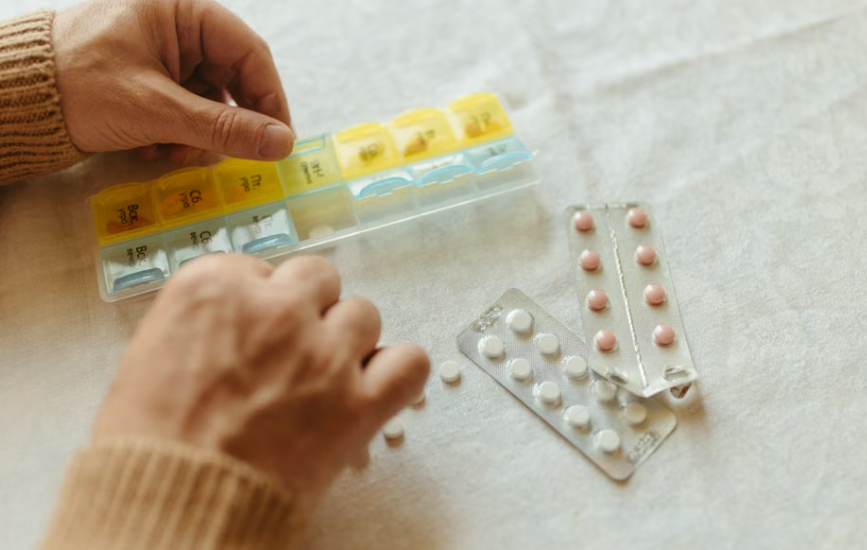
There is a particular kind of doubt that arrives around mid-morning. The pills were taken — probably. The bottle was on the counter — it usually is. Nothing about the scene confirms anything.
For one medicine this is harmless. For four, taken at different times, the uncertainty becomes a small daily tax on everyone in the house, including the person who calls at lunchtime to ask.
Why the load grows quietly
In 2021–2022, 88.6% of adults age 65 and older had taken prescription medication in the past year [1]. The National Institute on Aging notes that people 65 and older tend to take more medicines than any other age group, and that keeping track of several at once can be difficult [2].
Prescriptions also arrive from different appointments at different times, so the routine is rarely designed. It accumulates.
What health organisations recommend
The recurring advice is unglamorous and mostly organisational.
Keep one written list
The NIA advises keeping track of all medicines — prescription, over-the-counter and supplements — and reviewing it with a doctor or pharmacist [2].
Take them at consistent times
A dose attached to breakfast or bedtime is easier to sustain than one attached to a clock alone.
Make skipped doses visible
A routine that shows its own state removes the need to reconstruct the morning.
Ask about side effects
The NIA lists talking with a provider about medication side effects among its fall-prevention tips [3].
Dispose of what is expired
Checking dates and discarding unused medicines reduces the chance of taking the wrong thing [2].
Small changes, meaningful difference
One practical consideration is separating the week in advance, so that each day has its own container and each container has its own times.
The second is portability. Routines break on the days that are different — an appointment, a lunch out, a weekend away — so the part of the week that travels matters.
Weekly pill organisers with detachable daily trays are one example of this kind of aid.
Other practical considerations
An automatic dispenser
Adds alarms and a locking lid for people who need the prompt as much as the layout.
Pharmacy dose packaging
Pre-packed doses by day and time, prepared by the pharmacy rather than at home.
A wall chart
A printed grid ticked off after each dose costs nothing and works well for one or two medicines.
Refill synchronisation
Ask the pharmacy to align refill dates so nothing runs out mid-week.
Visible beats remembered
Getting older does not have to mean handing over the medicine cabinet. In many cases a routine simply needs to be laid out where it can be seen, so that checking takes a glance rather than a phone call.
It is a ten-minute change on a Sunday, and it usually answers the question that started all of this.
Sources
- 1 Prescription Medication Use, Coverage, and Nonadherence Among Adults Age 65 and Older: United States, 2021–2022 (National Health Statistics Reports no. 209) National Center for Health Statistics, CDC
- 2 Taking Medicines Safely as You Age National Institute on Aging (NIH)
- 3 Six Tips To Help Prevent Falls National Institute on Aging (NIH)
Editorial review based on current public health and medical literature. This is not a personal recommendation from a named clinician.
Informational only. Speak to a qualified health professional about your own situation.
A short, useful letter on aging well at home
One article a fortnight on health, safety and daily living, with the sources attached. No spam, unsubscribe anytime.
An independent publication covering health, safety and daily living for older adults and the people who care for them. We do not sell products and we are not owned by anyone who does.
This content is for informational purposes only and is not intended to replace professional medical advice, diagnosis or treatment. Always speak to a qualified health professional about your own situation. If you think you are having a medical emergency, call your local emergency number.
This site is supported by display advertising. Advertisers have no involvement in what we cover or what we conclude, and no advertiser sees an article before it is published.
Editorial policy