Why Medication Routines Become Harder With Age — And What Actually Makes Them Easier
Almost nine in ten adults over 65 take prescription medication. Once the list reaches four or five, the difficulty is rarely the medicine itself. It is the schedule.
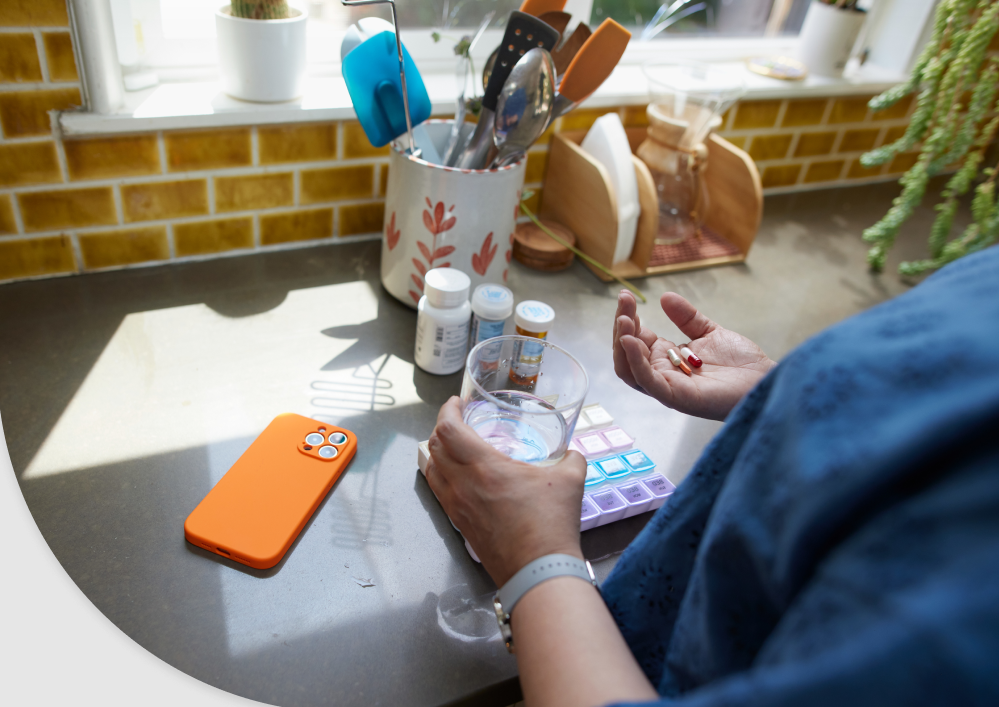
It usually starts with a small question, asked out loud in a quiet kitchen: did I already take the blue one?
Nobody writes that moment down. It passes, the day continues, and the doubt is resolved with a guess. Multiply it by four medicines, three times a day, seven days a week, and the guessing becomes the routine — which is the part families tend to notice only when something goes wrong.
What actually changes
Medication use rises steeply with age. In 2021–2022, 88.6% of adults age 65 and older had taken prescription medication in the past year, according to a National Center for Health Statistics report [1].
The National Institute on Aging notes that people age 65 and older tend to take more medicines than any other age group, often because several conditions are being treated at once, and that managing multiple medications can be expensive and difficult to track. The use of several drugs at the same time — polypharmacy — is described as a growing concern for older adults [2].
None of this is a memory problem. A schedule with six moving parts is a logistics problem, and logistics problems respond to systems rather than to effort.
What health organisations recommend
Public health bodies converge on the same practical ground. None of it is dramatic, and all of it is available today.
Keep one current list
The NIA advises keeping track of all medicines — prescription, over-the-counter and supplements — and reviewing that list with a doctor or pharmacist [2].
Review the whole regimen periodically
Because taking several medicines at once is a recognised concern, the list itself deserves a check-up, not only the conditions it treats [2].
Ask about side effects that affect balance
Among its fall-prevention tips, the NIA puts talking to a provider about medication side effects first [3].
Anchor doses to fixed points in the day
Attaching medicines to meals, coffee or bedtime turns a schedule into a habit, and habits survive distraction better than intentions do.
Clear out what is no longer needed
The NIA recommends checking expiration dates and disposing of unused or expired medicines promptly [2].
Small changes, meaningful difference
One practical consideration is making the current dose the only visible dose. Most confusion comes from having the whole week within reach at once: nothing about an open cupboard tells you whether Tuesday morning already happened.
The second is removing the recall step altogether. If the container itself signals the time, the person is no longer being asked to remember — only to respond.
Automatic pill dispensers with timed alarms and a locking lid are one example of this kind of aid. They do not change the prescription; they change how the schedule is presented.

Other practical considerations
A weekly tray you fill yourself
Seven compartments make a missed dose visible at a glance, with nothing to charge and nothing to set up.
Pharmacy dose packaging
Many pharmacies will pre-pack doses by day and time, or synchronise refills so everything is collected on one date.
Phone or clock alarms
Free, and effective for one or two medicines — less so once the times multiply.
A pharmacist review
A full list review can sometimes simplify the schedule itself, which beats managing a complicated one.
The routine is the treatment
Medicines only work as prescribed if they are taken as prescribed, and after a certain number of them the deciding factor is no longer discipline — it is design. A schedule that is visible, timed and hard to double-count asks less of everyone involved.
That is worth a conversation at the next appointment, and worth ten minutes at the kitchen table this week.
Sources
- 1 Prescription Medication Use, Coverage, and Nonadherence Among Adults Age 65 and Older: United States, 2021–2022 (National Health Statistics Reports no. 209) National Center for Health Statistics, CDC
- 2 Taking Medicines Safely as You Age National Institute on Aging (NIH)
- 3 Six Tips To Help Prevent Falls National Institute on Aging (NIH)
Editorial review based on current public health and medical literature. This is not a personal recommendation from a named clinician.
Informational only. Speak to a qualified health professional about your own situation.
A short, useful letter on aging well at home
One article a fortnight on health, safety and daily living, with the sources attached. No spam, unsubscribe anytime.
An independent publication covering health, safety and daily living for older adults and the people who care for them. We do not sell products and we are not owned by anyone who does.
This content is for informational purposes only and is not intended to replace professional medical advice, diagnosis or treatment. Always speak to a qualified health professional about your own situation. If you think you are having a medical emergency, call your local emergency number.
This site is supported by display advertising. Advertisers have no involvement in what we cover or what we conclude, and no advertiser sees an article before it is published.
Editorial policy