Nighttime Mobility and Fall Prevention: Small Changes That Make a Difference
Getting out of bed is one of the least considered movements of the day, and one of the least stable.
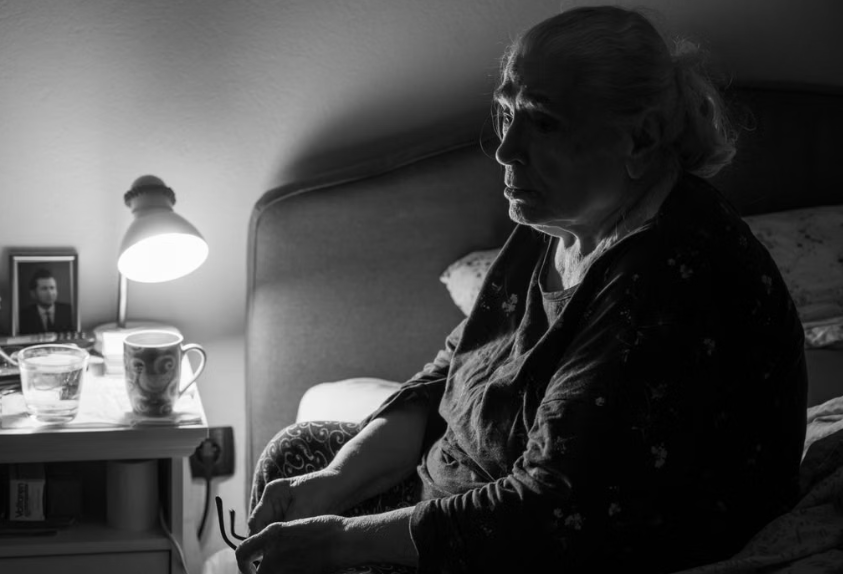
Sitting up, swinging both legs across, standing, turning: four movements, performed half asleep, in the dark, without looking. Most people do it for decades without giving it a thought.
Then one night the room tilts slightly, a hand goes out for the nightstand, and the nightstand moves. Nothing happens. It is remembered anyway.
What actually changes
Falls are the leading cause of injury for adults aged 65 and older, and over 14 million — roughly one in four — report falling each year [1]. Falling once doubles the chances of falling again [2].
Standing up is its own moment of risk. Blood pressure can drop on rising, causing lightheadedness or dizziness; Mayo Clinic describes this as orthostatic hypotension [3], and Cleveland Clinic notes it happens more often, and with more severe symptoms, in the morning, when blood pressure is naturally at its lowest [4].
That is why “stand up slowly to avoid dizziness” appears in the National Institute on Aging's six fall-prevention tips [5] — and why what the hand finds on the way up matters.
What health organisations recommend
For the bedroom, published guidance concentrates on three things: light, a clear path, and something stable to hold.
Stand up slowly
Named directly in the NIA's fall-prevention tips as a way to avoid dizziness [5].
Light the route before you take it
The NIA recommends night lights and light switches close to the bed, and a flashlight within reach [6].
Keep the path clear
Cords along walls, no clutter on the floor, carpets secured [6][7].
Check that furniture is the right height
The NIA advises that chairs and sofas should be a height you can get in and out of easily — the same logic applies to a bed [6].
Add support where it is used
Handrails in the bathroom and on both sides of stairs are standard advice; the principle is a fixed handhold at the point of transfer [6].
Small changes, meaningful difference
One practical consideration is that the support point beside the bed is usually improvised. A nightstand slides, a chair tips, a headboard is at the wrong angle — none of them were designed to take weight.
The second is consistency: a handhold is only useful if it is in the same place every night, at a height that suits the person rather than the furniture.
Bed assist rails are one example of this type of home modification. They are not appropriate for everyone — for someone with confusion, restlessness at night or significant mobility limits, ask a clinician or physiotherapist before adding one.
Other practical considerations
Bed height
Feet flat on the floor with knees roughly level with hips makes standing up a smaller task.
A pause before standing
Sitting on the edge of the bed for a moment gives blood pressure time to settle.
Automatic light on the route
The path matters as much as the first step off the bed.
A strength and balance assessment
A physiotherapist can often address the underlying steadiness rather than only the environment.
Design the first thirty seconds
Getting older does not necessarily mean giving up independence. It does mean that a few ordinary movements deserve more thought than they used to — and the first thirty seconds after waking is one of them.
Light on the route, a clear floor, and one fixed thing to hold: that is most of the intervention.
Sources
- 1 Older Adult Falls Data CDC, National Center for Injury Prevention and Control
- 2 Facts About Falls CDC, Older Adult Fall Prevention
- 3 Orthostatic hypotension (postural hypotension) Mayo Clinic
- 4 Orthostatic Hypotension Cleveland Clinic
- 5 Six Tips To Help Prevent Falls National Institute on Aging (NIH)
- 6 Preventing Falls at Home: Room by Room National Institute on Aging (NIH)
- 7 Home Safety Tips for Older Adults National Institute on Aging (NIH)
Editorial review based on current public health and medical literature. This is not a personal recommendation from a named clinician.
Informational only. Speak to a qualified health professional about your own situation.
A short, useful letter on aging well at home
One article a fortnight on health, safety and daily living, with the sources attached. No spam, unsubscribe anytime.
An independent publication covering health, safety and daily living for older adults and the people who care for them. We do not sell products and we are not owned by anyone who does.
This content is for informational purposes only and is not intended to replace professional medical advice, diagnosis or treatment. Always speak to a qualified health professional about your own situation. If you think you are having a medical emergency, call your local emergency number.
This site is supported by display advertising. Advertisers have no involvement in what we cover or what we conclude, and no advertiser sees an article before it is published.
Editorial policy